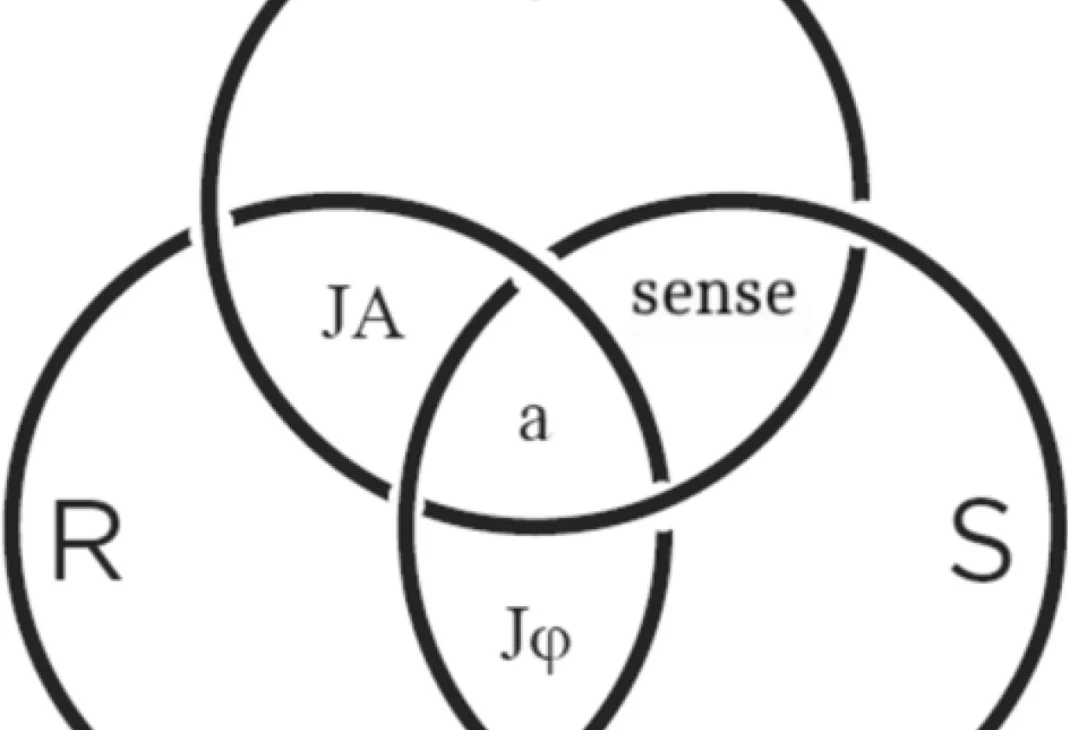
To speak the truth, one must speak a lie. One of two men who meet at a train station tells the other that he is going to Lemberg. The other replies: “If you are going to Lemberg, why do you tell me you are going to Lemberg? Is it so that I will believe you are going to Cracow?” Why does this suspicious man search for something lurking behind what is said?
An expression, a sign, exists to represent something that cannot account for itself. During this representation, meaning is forged between the signifier and the signified. An act of intending is at play here. But is there any need to state what is self-evident? Does the obvious constitute a message at all? It is precisely for this reason that during this operation of substitution, the signifier tells a lie; it acts as though it represents what lies behind it in its entirety. It accentuates a unary trait, reverses it, distorts its form. Thus, I suppose one could even say it caricatures it.
To consider another example: the proposition “The present King of France is bald” sparks a disagreement regarding its truth value between Russell and Strawson, given the absence of a monarchy at the time. In short, while Russell argues that the proposition is false because there is no king, Strawson contends that because the presupposition is flawed, the proposition cannot even be evaluated. Yet, from the perspective of the psychoanalytic clinic, what can we say about the truth of this sentence?
For the subject making the claim of baldness, the existence of the king—which we can uncover retroactively (nachträglich)—is a prerequisite. The remainder of their speech can only be constructed upon this ground. This condition may well be inexplicable, yet the rest of the proposition is explained by it. For analysis, truth occupies precisely such a position.
This is why truth cannot be taught to a subject by someone else. Perhaps partial representations of truth can be discerned. I say “partial” because when the unconscious opens—appearing only to close just as swiftly—the truth that emerges is merely a truth for that fleeting moment. Behind it lie other truths that cannot be articulated. The signifiers of this truth revolve incessantly around a hole; they demarcate the void, give it form, attempt to master it, yet continually circle around that very void. In Lacanian practice, the cut of the session—the scansion—is positioned precisely at this boundary. And this boundary is where the Vorstellungsrepräsentanz, the S1, that is, the master signifier winks at the Other. Yet this “code,” situated in the Symbolic and producing Imaginary “messages,” ultimately fails to represent the Real in its totality. It lies, masquerading as truth itself; yet it remains an indispensable proxy insofar as it announces that which stays concealed. It is by virtue of this simultaneous operation of representation and concealment that an attraction toward the concealed is generated. Desire becomes possible.
Truth becomes possible through a lie, through a staging; desire, through repression. The repressions that act as delegates of primal repression give birth to truth—which itself stands in for a primal lack—and are represented through them. The speech spoken in every session resembles micro-functions emerging from a macro-function; consider, for instance, the specific fantasies born out of the fundamental fantasy: one can observe in each of them an attempt to substitute for that very same narrative. The exact same mechanism applies to the end of analysis: on a micro-plane, the end of a session stages the end of analysis itself. Analysis comes to an end when the subject passes through the same place twice. Gather these second crossings, these upheavals, and look behind them: you will find them arranged around a common void, veiling it.
They strive to articulate an unpronounceable truth, for truth always insists in the unconscious, cloaking itself in “diminutive truths” (vérités/truthlets). Conversely, even when lying, we convey the truth (whether it is heard or not), because a foundation is required upon which that lie can be erected.
It is for this very reason that to enunciate the truth, one must borrow a mendacious utterance.
For that lie confronts us as if it were the very thing that cannot be enunciated; we look at yet another of its opposites, and there, an encounter takes place with what lies behind the lie.
Kaynakça
- Lacan, J. (1998). The four fundamental concepts of psychoanalysis: The seminar of Jacques Lacan, Book 11 (J.-A. Miller, Ed.; A. Sheridan, Trans.). W. W. Norton & Company.
- Lacan, J. (2017). Formations of the unconscious: The seminar of Jacques Lacan, Book V (J.-A. Miller, Ed.; R. Grigg, Trans.). Polity.