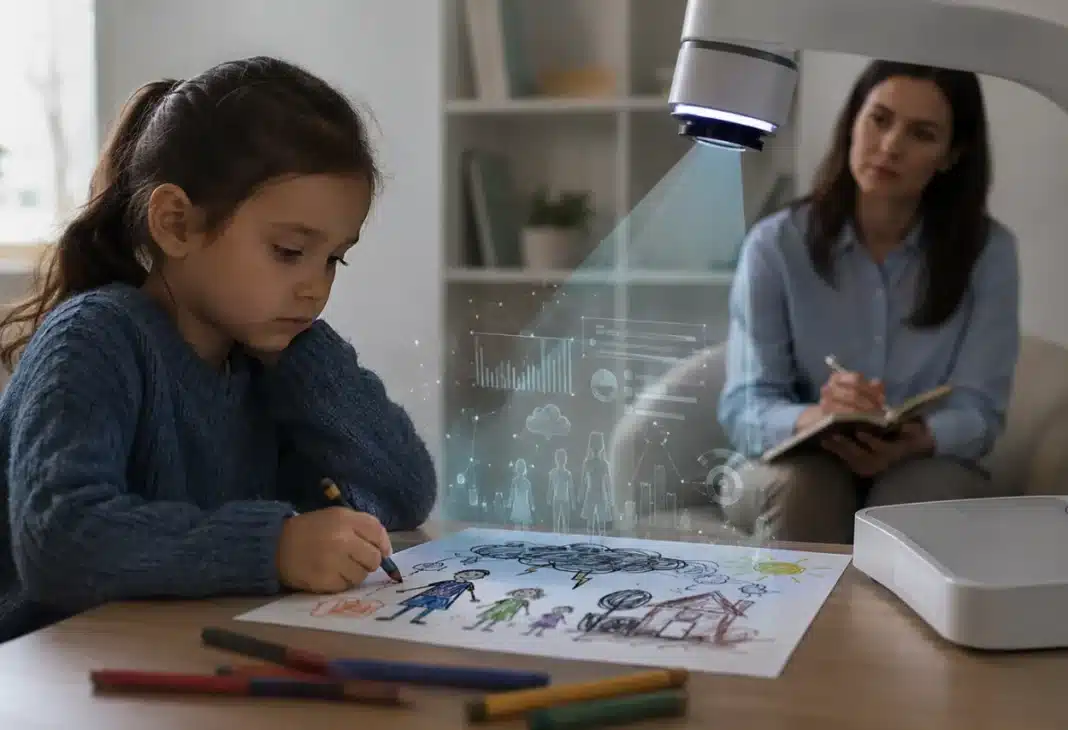
Children are not always able to verbalize their feelings. Experiences such as fear, sadness, anger, shame, illness, and family conflict can be difficult to express through language, especially for very young children. From this perspective, drawing may offer a helpful and less intimidating form of communication. Drawings may help professionals understand how children see the world and begin conversations about their relationships and emotions (Fabris et al., 2023).
Still, it is unwise to think that a drawing gives a full or perfect picture of the child’s inner world. One element can have various interpretations. For example, a small figure may be associated with insecurity, but it may also reflect limited drawing skills, lack of space, or a simple artistic choice. The use of dark colors may be associated with sadness, but a dark pencil may simply be the only one available. Thomas and Jolley (1998) argued that children’s drawings are too ambiguous to serve as reliable stand-alone measures of personality or emotional state. Their meanings should be explored through interviews, observations, developmental factors, family context, and the child’s own explanation.
This consideration has become especially topical in connection with the development of artificial intelligence in psychology and education. Researchers have developed systems that can analyze emotions, identify possible psychological concerns, and generate reports based on children’s drawings (Ali et al., 2022; Farhad et al., 2025; Shah et al., 2025). Because these systems use computer vision, machine learning, and multimodal language models, their conclusions may appear more scientific than human interpretations of children’s drawings. However, the central question is whether the meaning produced by the system truly comes from the child.
Algorithmic Projection
In psychology, projection commonly describes a process in which people place their own unwanted feelings, wishes, or fears onto someone else. A similar danger can appear when adults interpret children’s drawings. A clinician, parent, or teacher may see anxiety, aggression, trauma, or family conflict because these meanings already exist in the adult’s theoretical expectations. The drawing then becomes a surface on which adult beliefs are placed.
AI systems do not possess an unconscious mind in the human sense. They have no childhood, personal fears, private wishes, or hidden memories. Nevertheless, AI is trained on data created and selected by human beings. Humans provide the training material, select relevant examples, define the categories, assign the labels, and establish the criteria for interpretation.
This article uses the term algorithmic projection to describe the process through which adult expectations, cultural beliefs, and uncertain psychological theories are transferred onto a child’s drawing through an AI system. The algorithm does not necessarily remove subjectivity. Instead, it may hide subjectivity behind probability scores, automated reports, and scientific-looking explanations.
Shah et al. (2025), for example, developed a multimodal framework designed to produce descriptions, emotional themes, assessments, and recommendations from children’s artwork. The authors presented the results as initial evaluations rather than formal clinical assessments. Even so, the training process illustrates why caution is needed: a large language model contributed to the annotation of thousands of images. This creates the possibility that one model’s assumptions can become training material for another. A system may then repeat earlier interpretations without making their uncertainty visible.
The Illusion of Objectivity
AI systems are often valued for their ability to analyze large datasets, identify patterns in images, and apply the same process to each image. This consistency can be beneficial, especially when human judgments are affected by fatigue or personal preferences. Consistency, however, does not guarantee accuracy; a system can repeat the same type of error consistently.
For instance, Ali et al. (2022) trained an application to classify children’s drawings as expressing either positive or negative emotions. They found that accuracy varied considerably across several experiments and emphasized the need for further training and evaluation. Farhad et al. (2025) developed another AI system using Draw-a-Person images to suggest whether a child might need further psychological referral. While the model produced promising results, the categories of the system were still defined by human experts and limited by several constraints.
The examples above demonstrate the potential usefulness of AI in screening, but screening does not necessarily equal diagnosis. A model may learn that a visual feature often appears in drawings labeled “need referral.” It still cannot know why that feature appears in one particular child’s picture. The child may be distressed, but the feature may also relate to motor development, artistic style, cultural convention, task instructions, copying, or ordinary preference.
Automated reports may also create confirmation bias. Once an AI tool describes a child as anxious, aggressive, withdrawn, or traumatized, adults may begin to interpret later behavior through that label. A teacher may pay more attention to signs of fear. A parent may ask leading questions. A clinician may notice evidence that supports the report while overlooking information that challenges it. An uncertain prediction can therefore become a powerful story about the child.
The Limits of Projective Meaning
Research on projective drawings already provides strong reasons for caution. Thomas and Jolley (1998) found limited support for using drawings alone to assess children’s personality or emotional state. Allen and Tussey’s (2012) systematic review reached an especially important conclusion concerning abuse: no individual graphic sign or scoring system had sufficient evidence to determine reliably whether a child had experienced physical or sexual abuse.
This does not mean that drawings have no psychological value. They can support communication, help children describe experiences, and give professionals useful material for further discussion. The problem begins when a possible interpretation is presented as an objective psychological truth. Although a drawing may help professionals formulate better questions, it should not be treated as evidence of a diagnosis, family problems, or traumatic experience.
AI may intensify this problem because machine-generated conclusions can appear less subjective than human opinions. A statement such as “this feature is associated with insecurity” sounds cautious when spoken by a clinician, but it may appear more authoritative when accompanied by a percentage, colored risk score, or automated recommendation. The numerical representation may give the impression of exactness even though there is uncertainty in the construct itself.
Differences in Culture, Development, and Neurodiversity
Drawings of children are influenced by various aspects including age, culture, socio-economic status, and environment. Restoy et al. (2022) examined 958 self-portraits created by children from 35 countries and found that cultural and developmental factors influenced both the content and complexity of their drawings.
A model trained mainly on one population may misunderstand children from another. A large grandparent figure may represent closeness and respect in an extended-family household rather than parental absence. Clothing, houses, colors, religious symbols, and family roles may carry different meanings in different communities. If a model treats one cultural pattern as normal, it may transform difference into pathology.
The importance of development cannot be overstated here. Children of different ages vary in their control of proportion, detail, perspective, and body structure in drawings. A missing hand, an unusual body size, or a floating figure may reflect ordinary developmental differences rather than psychological distress. Children with neurodevelopmental differences may use repetition, spatial arrangement, detail, or color differently from typical expectations.
In the absence of representative data, the system may incorrectly classify such differences as indicators of distress. A statistical average does not explain the experience of a particular child.
Privacy and the Digital Child
Children’s drawings may contain highly sensitive information. They can show names, family members, homes, hospital experiences, violence, illness, fears, and private events. Uploading these images to an AI platform raises questions about consent, storage, security, reuse, and future access. Children may not fully understand how their drawings could be analyzed, copied, stored, or reused to train future systems.
UNICEF’s (2025) guidance on AI and children emphasizes safety, privacy, fairness, inclusion, transparency, explainability, and accountability. These principles are especially important when technology processes material connected to a child’s psychological life. Parents may provide legal consent, but ethical practice should also involve children in decisions in ways appropriate to their age and understanding.
A drawing created during a difficult period should not automatically become part of a permanent psychological profile. AI systems should collect only necessary data, remove identifying information, clearly explain whether images will be stored or reused, and provide accessible options for deletion.
A Support Tool, Not an Artificial Clinician
AI may still have a responsible role in this field. A carefully designed system could organize basic observations, identify repeated themes across several drawings, or help professionals notice details worth discussing. It might support research using ethically collected and anonymized datasets. It could also help track changes over time when combined with interviews, behavior, and other assessment information.
However, its language should remain descriptive rather than diagnostic. Instead of stating, “The small self-figure shows low self-esteem,” a safer system might report, “The self-figure is smaller than the other figures. This feature has several possible explanations and should be discussed with the child.” The first statement closes interpretation; the second opens a question.
The child’s own explanation must have priority. Questions such as “Who is this?”, “What is happening here?”, “Why did you choose this color?”, and “How does this person feel?” can reveal meanings that no algorithm can safely predict. AI should support this conversation rather than replace it.
Professionals must also consider the limitations of the tool. They need to understand how the system was trained, which populations were represented in its data, what outcomes were measured, and where errors are most likely to occur. A complex tool should not be trusted merely because its internal processes are difficult to understand.
Conclusion
The greatest danger is not that AI will understand children’s drawings too deeply. It is that adults will believe it understands more than it does. Automated interpretation may turn uncertain cultural and clinical assumptions into official-looking conclusions.
An AI system has no unconscious of its own, but its outputs contain traces of the people who selected its data, designed its labels, and defined its theories. When it claims to read a child’s inner world, it may instead reproduce a collective archive of adult expectations.
A child’s drawing should be a starting point for conversation, not the end of it. AI may help professionals organize observations, identify patterns, and formulate careful questions, but it should never dictate the conversation. The most responsible question is therefore not simply, “What does the algorithm see?” It is, “What have we taught the algorithm to see, and what does the child say the drawing means?”
Kaynakça
- Ali, N., Abd-Alrazaq, A., Shah, Z., Alajlani, M., Alam, T., & Househ, M. (2022). Artificial intelligence-based mobile application for sensing children emotion through drawings. Studies in Health Technology and Informatics, 295, 118–121. https://doi.org/10.3233/SHTI220675
- Allen, B., & Tussey, C. (2012). Can projective drawings detect if a child experienced sexual or physical abuse? A systematic review of the controlled research. Trauma, Violence, & Abuse, 13(2), 97–111. https://doi.org/10.1177/1524838012440339
- Fabris, M. A., Lange-Küttner, C., Shiakou, M., & Longobardi, C. (2023). Editorial: Children’s drawings: Evidence-based research and practice. Frontiers in Psychology, 14, Article 1250556. https://doi.org/10.3389/fpsyg.2023.1250556
- Farhad, M., Masud, M. M., Alnaqbi, A., Mubarak, R., Aladawi, A., & Alnaqbi, S. (2025). From crayons to code: AI-driven insights into a child’s mental health through drawings. Proceedings of the AAAI Conference on Artificial Intelligence, 39(28), 28923–28929. https://doi.org/10.1609/aaai.v39i28.35160
- Restoy, S., Martinet, L., Sueur, C., & Pelé, M. (2022). Draw yourself: How culture influences drawings by children between the ages of two and fifteen. Frontiers in Psychology, 13, Article 940617. https://doi.org/10.3389/fpsyg.2022.940617
- Shah, U., Khan, N., Alzubaidi, M., Agus, M., & Househ, M. (2025). ArtInsight: A multimodal AI framework for interpreting children’s drawings and enhancing emotional understanding. Studies in Health Technology and Informatics, 327, 808–812. https://doi.org/10.3233/SHTI250471
- Thomas, G. V., & Jolley, R. P. (1998). Drawing conclusions: A re-examination of empirical and conceptual bases for psychological evaluation of children from their drawings. British Journal of Clinical Psychology, 37(2), 127–139. https://doi.org/10.1111/j.2044-8260.1998.tb01289.x
- UNICEF. (2025). Guidance on AI and children: Version 3.0. UNICEF Innocenti.